It began, as these moments often do, in the quiet space between ordinary tasks. I was clearing the dinner table, already thinking about the next day, when a headline lit up my phone: Spanish police review the Roblox chats in the suicide of a nine‑year‑old boy in Valencia1. The initial report was disturbing, and a follow‑up confirmed that investigators were examining possible online harassment or inducement, even though the child had shown no warning signs at home or school. A tension rose in my chest.
“Do you also play Roblox?” I asked my fifteen‑year‑old son as he passed me in the hallway. He gave me that familiar mix of amusement and suspicion. “No, Mom. That’s for little kids. Are you asking because of the pedophiles?” His casual certainty startled me, not just for what he said but for how easily he said it. He walked off before I could ask more, leaving me with concern and something sharper: shame at how little I knew about a platform used daily by tens of millions of children.
How could something marketed as “for kids” appear in numerous police investigations both in the US and Europe, pediatric warnings, and international headlines raising concerns about children’s online safety and exposure to inappropriate content?
That night, I began my own descent into Roblox.
Games Engineered on Fractured Foundations: The Roblox Infrastructure
When David Baszucki and Erik Cassel launched Roblox in 20062, they imagined a playful laboratory of creativity, not a social platform or game distribution ecosystem. The creators intended Roblox to be a place where users could build interactive environments, experiment with physics, and learn through creation.
Two decades later, the platform hosts around 144 million daily active users, with nearly 50% under the age of 133, a demographic that considerably complicates the platform’s multi-functional nature.
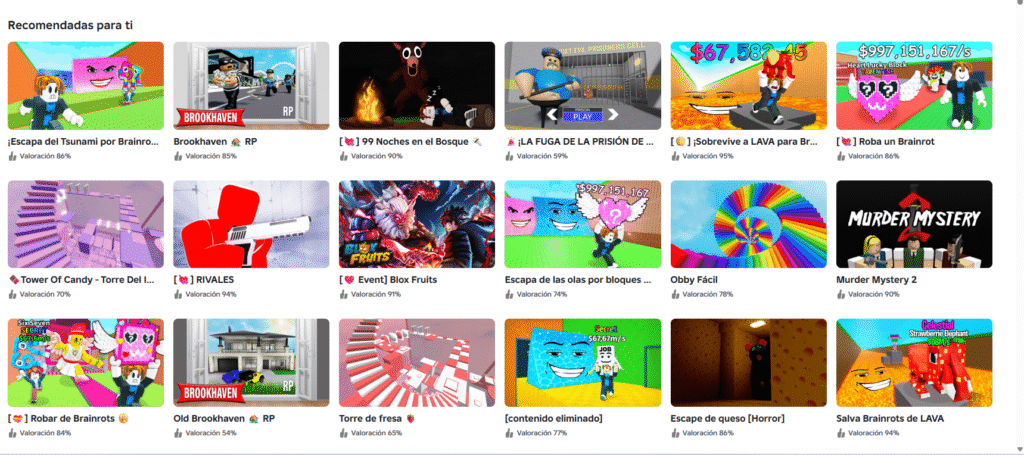
(source: https://www.roblox.com/home 10.03.2026)
Roblox operates as a hybrid entity: simultaneously a game-development engine, a social network, and a primary chat-based communication hub.
It also runs its own virtual economy, built on a proprietary currency called Robux4, which children use to purchase avatar clothing, weapons, vehicles, pets, and “VIP” in-game upgrades.

(source: https://www.roblox.com/home 10.03.2026)
This hybridity is both the platform’s triumph and its catastrophe.
Revealing Reality, an independent insight and innovation agency, investigated how permeable Roblox’s infrastructure truly is5. What their researchers found is unsettling, not because of isolated incidents, but because of how effortlessly the system allows them to happen. By creating avatars registered as five-year-olds, they were able to move through the platform almost unnoticed, by entering spaces where adults interacted with them freely, often using coded language to slip past safety filters.
I decided to conduct my own brief investigation under the username Mycookie. The process took less than a minute. There was no identity verification. No email confirmation. Entering the birth year of an eight-year-old was sufficient for full platform access.
My initial impression was that the experience departed sharply from the cheerful, pastel‑colored environment I had expected, as I instead encountered avatars with overtly sexualized aesthetics that revealed a safety architecture poorly aligned with a predominantly young user base; I will return to this point later when situating it within one of the four harm vectors.
To understand how a “kids’ game” becomes the subject of a police review in Valencia, one must look at the specific ways the platform’s architecture fails its users. These failures are consolidated in what I call four distinct vectors of harm.
The Four Vectors of Harm and Online Safety Risks for Children
Harm Vector 1: Behavioral Addiction and Developmental Harm
Several studies about Roblox consistently link the game’s addictive tendencies to significant declines in core mental health indicators, including self-acceptance and sense of life purpose. The study found these declines in users of all ages, but 13 – 18 year old players exhibited the highest levels of addiction and the lowest psychological well-being6. These findings align with clinical alarms raised by the Spanish Association of Pediatrics (AEP). In September 2025, the AEP and the Spanish Society of Adolescent Medicine (SEMA)7 issued an urgent joint warning after observing an “alarming increase” in consultations involving minors who exhibited severe psychological symptoms following Roblox interactions. These symptoms ranged from self-harm behaviors and suicidal ideation to heightened anxiety, insomnia, and social withdrawal.
The human reality behind these statistics is difficult to ignore. A personal contact recently shared a photograph of her daughter in the grip of a full meltdown after her parents took Roblox away, which is a reminder to all of us that the addiction leads to lived family crises.
Harm Vector 2: Radicalization and Extremist Recruitment
Extremist groups are exploiting Roblox to radicalize and recruit young users, despite the platform’s significant investment in trust and safety infrastructure. Two documented cases in Germany describe 12-year-old boys being exposed to far-right content through WWII-themed games within Roblox, where older players used Nazi symbolism to build rapport. The extremists then convinced the boys to join Discord servers, which they used to indoctrinate them with extremist propaganda8. A case from Singapore involved a 16-year-old who created Islamic State propaganda using Roblox footage and pledged allegiance to an in-game caliphate9.
The platform is structurally vulnerable to this kind of exploitation. Its enormous user base, counting over 150 million daily active users, combined with its open-ended design means that bad actors build immersive ideological environments from the ground up10.
While Roblox has introduced more than 100 safety features and an AI‑driven moderation system called Sentinel, the sheer scale of daily activity, which includes 6.1 billion chat messages and 1.1 million hours of voice communication11, makes comprehensive oversight functionally difficult.
Harm Vector 3: Grooming and Sexual Predation
Because Roblox allows communication through in-game chat, private messages, and user-created environments, it creates sustained opportunities for predatory adults to interact with children under the guise of gameplay. Researchers and child safety advocates have documented cases in which adults used the platform to build trust with minors over time before attempting to migrate conversations to less-monitored platforms or solicit inappropriate content.
In its October 2024 short-seller report on Roblox, Hindenburg Research tracked members of a network it described as “Adult Studios” and identified 38 Roblox groups, one with 103,000 members, openly soliciting sexual favors and trading child sexual abuse material12. Roblox has since removed these groups. By registering as children, the researchers were also able to access games like “Escape to Epstein Island” and “Diddy Party”. These were not hidden corners of the dark web, but searchable, user-generated environments where the platform’s filters failed to provide safety for children. This report, published on October 8, 2024, concluded that due to the lack of meaningful screening, Roblox’s social media features allowed predators to efficiently target hundreds of children.
A Bloomberg Businessweek investigation13 revealed that since 2018, U.S. law enforcement has arrested at least two dozen individuals for the abduction or abuse of children they initially met and groomed on Roblox. The report highlights deep-seated safety concerns within the popular gaming platform, where critics and former employees suggest that rapid user growth has been prioritized over the effective moderation of predatory behavior. Roblox has since added moderation tools, chat filters, and parental controls, but critics argue that these measures remain insufficient.
Together, these cases reflect wider forms of digital violence increasingly recognized in contemporary debates on nonviolent digital movements.
Harm Vector 4: Sexual Content and Objectification
In addition to the potential from sexual predation, Roblox allows for the creation of inappropriate and sexual material not suitable for children. The platform hosts user-generated spaces described in multiple investigations as ‘highly suggestive,’ featuring sexualized role-play and fetishistic themes accessible with a single click.
As I mentioned before, I encountered overtly sexualized avatar aesthetics upon first login, which illustrates the gap between Roblox’s age-appropriate branding and its actual content.

(source: https://www.roblox.com/home 10.03.2026)
The developmental consequences of such sexualization are not speculative. Research and advocacy literature on self-objectification in girls exposed to sexually objectified imagery document consistent associations with increased anxiety, depression, disordered eating, and diminished sexual agency14. A child-oriented platform that normalizes objectification and sexualization in children constitutes a public health issue, not merely a content moderation failure.
Regulatory Responses – What Has Changed
As these concerns have escalated, regulators worldwide have taken notice and initiated more rigorous monitoring of Roblox. In response to scrutiny from the UK’s Ofcom and the EU’s Digital Services Act, Roblox implemented a worldwide “Age Check to Chat” mandate in January 2026, using facial estimation and ID verification to move beyond self-reported age data15. Turkey, Russia, and Egypt have completely banned Roblox due to the platform’s inability to reconcile its child-friendly branding with these structural vulnerabilities16, illustrating a widening rift between commercial ambition and the safety standards demanded by regulators worldwide.
In Russia’s case, regulators justified the ban by claiming that Roblox “disseminates extremist content, facilitates sexual exploitation of minors, and contains LGBTQ‑related material deemed illegal under Russian law.” Additionally regulators cited risks to the “spiritual and moral development of children” and noted the platform’s alleged popularity among child predators17.
The Surveillance Paradox: Peter Thiel, Persona, and Data Privacy
That “Age Check to Chat” function that Roblox now relies upon is powered by Persona18, an identity‑verification platform backed by Founders Fund, the venture capital firm co-founded by Peter Thiel19, who also co-founded Palantir Technologies. Peter Thiel has been instrumental in shaping contemporary data‑surveillance infrastructures.
To protect children from predators, parents are now asked to provide biometric facial scans to a company embedded in global intelligence infrastructure. This creates a paradox and a new secondary layer of concern: the “solution” to digital safety requires a level of data surrender that is its own kind of risk. As James Baker of the Open Rights Group noted, public unease is growing as users are compelled to hand over biometric data simply to access a game. These concerns become acute when the faces being scanned belong to children20.
Following public backlash and scrutiny over Persona’s data practices, Discord, which also used Persona’s age verification system, confirmed cutting ties with the compromising practice21. However, Roblox continues to rely on Persona for its global age‑assurance processes.
Vigilance Starts with Adults
These findings underscore a simple but urgent truth: protecting children online is not optional but foundational to any credible vision of a safe digital society. If we fail to confront the risks embedded in verification systems, engagement mechanics, and virtual economies, we leave young users to navigate environments they cannot reasonably understand, resist, or meaningfully opt out of. These systems are deliberately engineered to trigger dopamine‑driven reward loops that exploit the developing brain’s heightened sensitivity to novelty, social validation, and instant gratification. Resisting is difficult for anyone, let alone children.
This makes the role of adults even more critical. Parents are being asked to monitor digital ecosystems that evolve faster than most can realistically track, while educators increasingly need digital literacy and training to help children recognize manipulative design patterns and regulate their own engagement. Unless we equip the adults in a child’s life to understand these dynamics, we risk placing all responsibility on the very people least able to defend themselves. Safeguarding children online is therefore not only a regulatory obligation but a moral imperative, and as Nelson Mandela reminded us, “There can be no keener revelation of a society’s soul than the way in which it treats its children.” 22
References
Image Credits: Alec Favale auf Unsplash
- Levante-EMV. (2026, January 15). La Policía revisa los chats de Fortnite y Roblox del niño de 9 años que se suicidó en Navidad en Valencia. https://www.levante-emv.com/sucesos/2026/01/15/suicidio-menores-policia-revisa-chats-fortnite-roblox-nino-9-anos-suicidio-navidad-valencia-125690515.html
- Wikipedia. (n.d.). Roblox. Retrieved March 4, 2026, from https://en.wikipedia.org/wiki/Roblox
- Dutt, A. (2024, December 2). How many people play Roblox? (User & revenue statistics). Demand Sage. https://www.demandsage.com/how-many-people-play-roblox/
- American Academy of Pediatrics. (n.d.). Information about Roblox for parents. Center of Excellence on Social Media and Youth Mental Health. https://www.aap.org/en/patient-care/media-and-children/center-of-excellence-on-social-media-and-youth-mental-health/qa-portal/qa-portal-library/qa-portal-library-questions/information-about-roblox-for-parents
- Revealing Reality. (n.d.). A digital playground: The real guide to Roblox. https://revealingreality.co.uk/a-digital-playground-the-real-guide-to-roblox/
- ResearchGate. (2025). Roblox addiction and psychological well-being in Generation Z. https://www.researchgate.net/publication/399467831_Roblox_addiction_and_psychological_well-being_in_Generation_Z
- https://www.aeped.es/actualidad/los-pediatras-alertan-sobre-los-riesgos-los-chats-en-plataforma-roblox
- GNET. (2025, September 22). Virtual worlds, real threats: Violent extremist exploitation of Roblox and wider gaming ecosystems. https://gnet-research.org/2025/09/22/virtual-worlds-real-threats-violent-extremist-exploitation-of-roblox-and-wider-gaming-ecosystems/
- Internal Security Department. (2026, January 28). Issuance of restriction order under the Internal Security Act against Singaporean youth and updates on previous ISA orders. Government of Singapore. https://www.isd.gov.sg/news-and-resources/20260128-issuance-of-restriction-order-under-the-internal-security-act-against-singaporean-youth-and-updates-on-previous-isa-orders/
- Roblox. (n.d.). Metrics & insights. https://brands.roblox.com/metrics-insights
- Roblox. (2025, August). Open-sourcing Roblox Sentinel: Preemptive risk detection. https://about.roblox.com/newsroom/2025/08/open-sourcing-roblox-sentinel-preemptive-risk-detection
- Hindenburg Research. (n.d.). Roblox. https://hindenburgresearch.com/roblox/
- Carville, O., & D’Anastasio, C. (2024). Roblox has a pedophile problem. Bloomberg.
https://www.bloomberg.com/features/2024-roblox-pedophile-problem/ - Culture Reframed. (n.d.). The harmful effects of sexualized social media and gaming on young people. https://culturereframed.org/the-harmful-effects-of-sexualized-social-media-and-gaming-on-young-people/
- Roblox. (n.d.). Age estimation. https://about.roblox.com/age-estimation
- Wikipedia. (n.d.). Censorship of Roblox. Retrieved March 4, 2026, from https://en.wikipedia.org/wiki/Censorship_of_Roblox
- Roskomnadzor. (n.d.). Press news. https://rkn.gov.ru/press/news/news74971.htm
- Wikipedia contributors. (n.d.). Persona (identity verification service). Wikipedia. Retrieved March 10, 2026, from https://en.wikipedia.org/wiki/Persona_(identity_verification_service)
- Wikipedia contributors. (n.d.). Peter Thiel. Wikipedia. https://en.wikipedia.org/wiki/Peter_Thiel
- Open Rights Group. (n.d.). Roblox, Reddit and Discord users compelled to use biometric ID system backed by Palantir co-founder Peter Thiel. https://www.openrightsgroup.org/press-releases/roblox-reddit-and-discord-users-compelled-to-use-biometric-id-system-backed-by-palantir-co-founder-peter-thiel/
- Huamani, K. (2026, February 25). Discord postpones age verification rollout amid criticism, promises transparency. AP News. https://apnews.com/article/discord-age-verification-persona-thiel-05da0d12d3d2a8cfda8b670e07c40460
- South African Government. (n.d.). Nelson Mandela Children’s Fund launch speech, 8 May 1995. Retrieved March 10, 2026, from http://www.mandela.gov.za/mandela_speeches/1995/950508_nmcf.htm